Showing posts with label acetylcholine impact factor. Show all posts

Friday, 5 May 2017

Complications of Pharmacological Spasm Provocation Tests

We investigated the complications of spasm provocation tests, including acetylcholine (ACh) tests, ergonovine (ER) tests and adding ACh after ER tests, retrospectively. Methods: We performed 1546 ACh tests and 1114 ER tests during23 years, including 240 adding ACh after ER tests. 
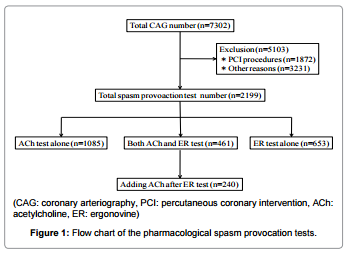


ACh (RCA: 20/50/(80) g, LCA: 20/50/100/(200) g) was injected incrementally over 20 seconds, whereas ER (RCA: 40 g, LCA: 64 g) was administered over 2-4 minutes. In addition, we administered adding intracoronary injection of ACh (RCA: 50/80 g, LCA: 100/200 g) after ER tests. Serious major complications were defined as ventricular fibrillation, sustained ventricular tachycardia, shock, severe hypotension (< 60 mmHg), cardiac arrest and cardiac tamponade. Read more>>>>>>>

Tuesday, 27 December 2016

Complications of Pharmacological Spasm Provocation Tests


As pharmacological spasm provocation tests, acetylcholine (ACh)  and ergonovine (ER) are employed in the cardiac catheterization laboratory. However, we often encounter the major and minor complications during performing these procedures. As a diagnostic tool, we should perform spasm provocation tests more safely without major complications. Multiple and proximal spasm documented by the pharmacological agents may occur a hemodynamic instability, such as shock and hypotension. Moreover, irreversible arrhythmia may be recognized. Selective spasm provocation tests such as intracoronary injection of ACh and ER is safer than the intravenous injection of ER. 
Pharmacological Spasm Provocation Tests


The effect time of ACh is very short and we may have the spontaneous remission of the provoked spasm. Therefore, we can perform a selective right and left coronary artery testing separately. We already reported the major complications during ACh spasm provocation tests in 2000. Serious major complications were not different from the reports with an intravenous injection of ER. Recently, we employed the sequential spasm provocation tests to document coronary spasm in the clinic. As sequential spasm provocation tests, we first perform intracoronary injection of ACh, second intracoronary administration of ER, and finally adding intracoronary injection of ACh just after ER test if we did not obtain the provoked spasm. Read more>>>>>>>>>>

Thursday, 8 September 2016

Complications of Pharmacological Spasm Provocation Tests

As pharmacological spasm provocation tests, acetylcholine (ACh) and ergonovine (ER) are employed in the cardiac catheterization laboratory. However, we often encounter the major and minor complications during performing these procedures. As a diagnostic tool, we should perform spasm provocation tests more safely without major complications. Multiple and proximal spasm documented by the pharmacological agents may occur a hemodynamic instability, such as shock and hypotension. Moreover, irreversible arrhythmia may be recognized. Selective spasmprovocation tests such as intracoronary injection of ACh and ER is safer than the intravenous injection of ER. The effect time of ACh is very short and we may have the spontaneous remission of the provoked spasm. Therefore, we can perform a selective right and left coronary artery testing separately. We already reported the major complications during ACh spasm provocation tests in 2000.

Spasm Provocation Tests
Serious major complications were not different from the reports with an intravenous injection of ER. Recently, we employed the sequential spasm provocation tests to document coronary spasm in the clinic . As sequential spasm provocation tests, we first perform intracoronary injection of ACh, second intracoronary administration of ER, and finally adding intracoronary injection of ACh just after ER test if we did not obtain the provoked spasm. However, the majority of cardiologists employed a single spasm provocation test for example ACh alone or ER only in each institution.